


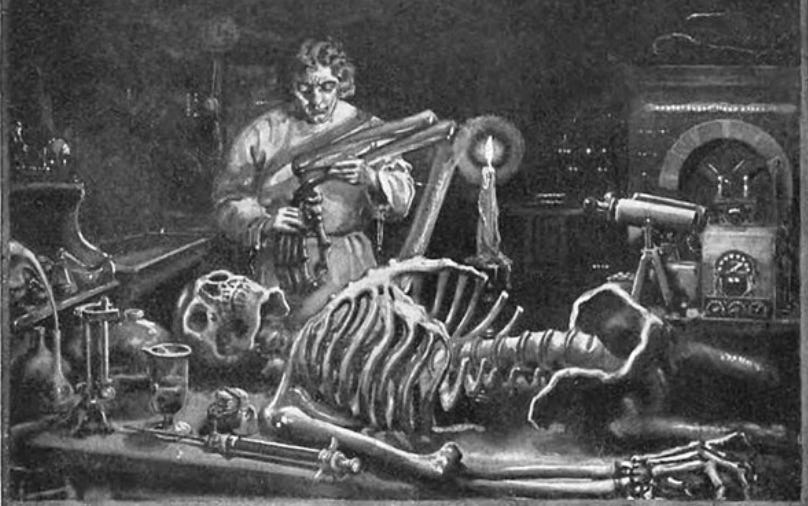
Throughout the course of Mary Shelley’s Frankenstein, there is rarely one voice. There is rarely a thread onto which the reader can hang, following its thoughts and crafting the narrative, the perfectly satisfying conclusion that we all desire. The voices, the characters, the locations themselves all merge into a unified, distinct, epitome of the story’s message, regardless of the novel’s narrator, regardless of the events themselves.
Everything, we can say, is subjective.
Upon its release in the early 19th century, such subjectivity was not celebrated. The complexity of the novel’s characters and interpretations was treated as an objective failure. “A tissue of disgusting and horrible absurdity”, the novel was often dismissed as nothing more than as “improbable and overstrained.” Reading alone was deemed insufficient; without maker’s knowledge, without proximity to the act of creation itself, the novel’s ambition was mistaken for excess.
When writing such criticism, or even partaking in everyday conversation, it can be remarkably easy to form an opinion. To shape your thoughts in such a way that an opinion is king, far removed from the outstanding evidence that presents itself to you. An opinion that can criticize or support is less nuanced than we think.
However, it is far more complacent to do such, to form an opinion, when criticizing something. To write a criticism, by definition, is to claim “the expression of disapproval of someone or something based on perceived faults or mistakes.” It is a posture that assumes distance is clarity, that judgment is insight.
Upon its founding in January 2025, nearly one year ago to the day, The Metropolitan Review has been anything but orthodox criticism. Claiming to host “serious, entertaining criticism that doesn’t pull any punches”, the journal is less about hard-nosed Pauline Kael-esque than it is their secondary mission: “reinvigorating high culture.” Less about arriving at conclusions than about staying with difficulty long enough for something meaningful to emerge.
When I spoke with Sam Jennings, one of TMR’s film critics, it became very evident that there was to be no objectivity in any of his writings – past, present, or future. There was to be no objectivity in the experience of watching films as a whole, in the mood you bring into the theater, the histories you carry with you, the private expectations you never realize you’re holding.
An American living in London, what Jennings keeps returning to in his work, and in our conversation, is maker’s knowledge: the concept that one only knows that they can make, that they can do. He was never meant to be a critic in the formal sense – no lineage, no theoretical spine, no appetite for verdicts. Criticism becomes a byproduct of attention rather than an ambition – a natural byproduct. The result of sitting with a project for long enough, of speculating without confronting those with opinions.
In this way, opinion is not the destination but the residue. Jennings is less interested in having one than in earning it, in allowing it to emerge only after attention has done its work. An opinion formed too quickly collapses complexity; one formed slowly begins to resemble understanding. His criticism does not aim to persuade so much as to linger, to hold space long enough for the contours of a work to show themselves. When enough of these partial views accumulate – when no single voice is allowed to dominate – something else begins to take shape.
A novel like Frankenstein, assembled from testimonies that never quite agree, from voices speaking past one another, each convinced they are closest to the truth, may have taken shape from criticism as such. Victor speaks from ambition, the Creature from aftermath, Walton from awe. Perspective laid atop perspective until something recognizable forms, not agreement nor certainty. But enough perspective, as Jennings says, to understand what was made, and what it cost, without needing it named.