


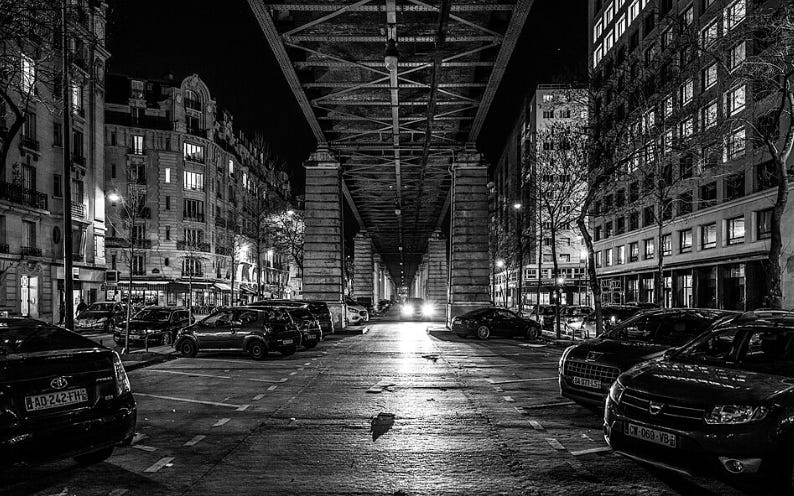
It has always been hard to imagine an empty street.
I believe there is a reason for that. Even if they are not the most potent, if you still have to squint to discern, to test whether or not you’ve drifted into a dream state, something will be illuminated by their streetlights. A newly-minted couple, hands brushing upon each other’s, each waiting for the grasp that relieves the shrilling tension in both of their shoulders. Or even a rat, scurrying along past the couple’s feet, solely hoping they don’t notice his descent into the sewer beneath their steps.
There is a reason why nearly 80% of the entire U.S. population – just shy of 265,000,000 people – lives in a densely populated urban area.
I am one of them. There are parts of Los Angeles that are undeniably beautiful. There are parts which we are naturally drawn to, the sprawling landscapes living in harmony with the focused street grids living in harmony with the families who thought they would like to see both but live in neither. If you asked a group of people living here how they would describe the city, there may be some outliers. But I can almost guarantee that the one recurring word is the one I led with: “beautiful.”
The same goes with most other cities. An undeniable pride – a sort of malaise that loops you into both infeasible depression and unbridled happiness, a pride that makes you concerned not for yourself, but for those in your life who have not shared the same experiences as you – is the primary symptom. It is as true for Los Angeles as it is for Boston as it is for Madison.
There is a reason why elections in such cities are widely contested cultural events. For both residents and non-residents, there is a sense that the outcome determines something about the cultural identity of its people, and subsequently, the people that share in their malaise. Those who were against Zohran Mamdani were forced to grapple with a culture that was falling out of line, a sense of connection that was more desperate than it was effective. Those who supported him, however, could see something of their own reflected back at them.
It is hard to imagine an empty street because there will never be one. There will always be big cities with big problems, and there will always be people waiting to both defend and complain about them. Some will dream of leaving and some will dream of returning, both convinced by the belief that the things that make it difficult to live are quite often what make it feel the most alive.
Even if we are forced to walk by rats, to wait in anticipation to see whether the mayor will advance to the next primary, to see the light flicker, shrouding us in darkness before illuminating us once again, the street will not be empty. As we walk, we know that the boy has inched closer now, that his fingers have interlocked with hers, that they have both stretched their necks towards the sky, craning, sighing into one another as they feel it leave their bodies.
it is so true that its hard to imagine, as i was planning my trup to Phu Quoc Vietnam last night, holyyyy, there's this place called Sun World, when i was researching and watching videos about it, the place looked just like a deserted movie set.